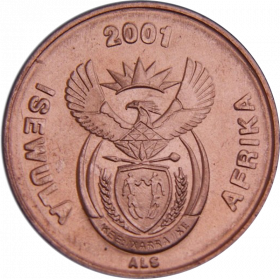
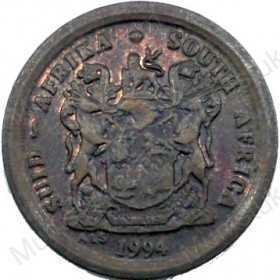
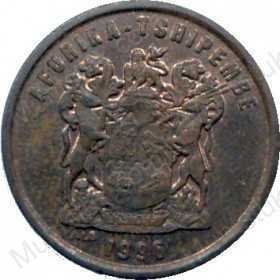
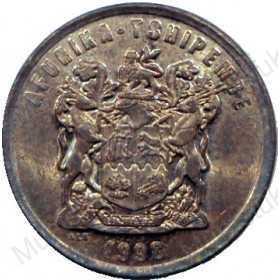
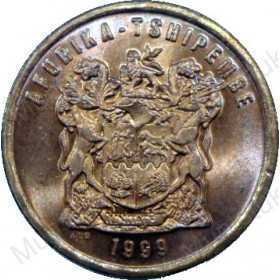
South Africa has six coin denominations in circulation, namely, the 10c, 20c, 50c, R1, R2 and the R5. These coins had different metal content and sizes. The 10c was the smallest(at 16mm) and the R5 is the largest diameter at 26mm. An important consideration in having the different sizes and rim finishes was that visually impaired people could identify the particular denomination with their fingers when transacting.
Circulation coins are made of metal or alloy. These coins are used in everyday transactions, circulating alongside banknotes. Various ridges, rims, serrations and different metals on the coins are incorporated as part of the security features. Machines such as vending machines are programmed with software and sensors to recognise these circulation coins and accept them accordingly.
Electroplated coins were introduced in 1989 as a solution to the escalating costs of materials and manufacturing and the increasing risk of falsification.
A bi-metal R5 coin was launched in 2004 to replace the R5 nickel coin.
The national flag of the Republic of South Africa(RSA) was adopted on Freedom Day, 27 April 1994, and first flown on the 10th May 1994 - the day Nelson Mandela was inaugurated as President. The central design of the flag, beginning at the flag pole in a V form and flowing into a single horizontal band to the outer edge of the fly, can be interpreted as the convergence of diverse elements within South African society.
Three different groups were introduced fo the third decimal series:
Series
Denomination
Design
Metal
Red Series
1c, 2, 5c
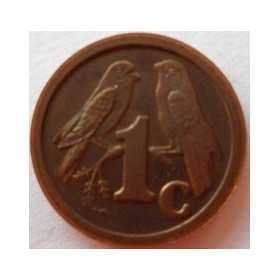
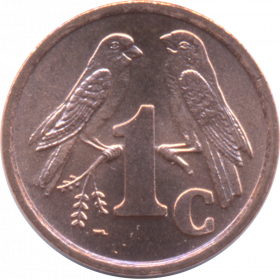
Birds(Blue Crane, Mossie)
Steel core plated with an allow of copper
Yellow Series
10c, 20c, 50c
Flowers(Arum Lilly, Streliztzia), Protea
Steel core plated with copper and tin
White Series
R1, R2, R5
Antelope(Springbok, Kudu, Wildebeest)
Copper core plated with nickel
R5 Coin(Weight 9.5gram, Diameter 26mm, released from 2004) - the Black Wildebeest or Gnu found in the northern grass veld regions of the Cape, throughout the Free State, KwaZulu Natal and the southern regions of Gauteng. The Black Wildebeest was also depicted on the 2c reverse from 1965 to 1990.
R2 Coin(Weight 5.6gram, Diameter 23m, released in 1989) - The Kudu, “King of Antelope”, was chosen for the reverse of the R2 coin which replaced the banknote in the 3rd decimal series. The wide spiralling horns are characteristic of the male kudu, which make it one of Africa’s most impressive antelope.
R1 Coin(Weight 4.0gram, Diameter 20mm, released in 1991) - The Springbok, South Africa’s national animal, was first depicted on the silver crown coins from 1947-1951 and 1953-1959. The Springbok was once again chosen for the reverse of the silver 50c (1961-1964), the gold £1 and gold £½ (1952-1960) and the gold R1 and R2 (1961-1964). It was again depicted on the 50c from 1960-1964. From 1977 to 1990, the Springbok appeared on the R1 nickel coins and from 1990 to date, on the smaller R1 in the 3rd series. The Springbok is also depicted on the reverse of our world-renowned Krugerrand.
50c Coin(Weight 5.0gram, Diameter 22mm, released from 1991) - The Strelitzia (Crane Flower or Bird-Of-Paradise Flower) first appeared together with the Arum Lily and Blue Agapanthus on the 50c coin (1965-1990) as part of the 2nd decimal series, and alone on the 50c in the 3rd series.
20c Coin(Weight 3.5gram, Diameter 19mm, released from 1992) - The King Protea, South Africa’s national flower, first appeared on the tickey and sixpence from 1925 to 1960 and again in the 1st decimal series (1961-1964) on the 2½c and 5c. The Protea was chosen for the reverse of the 20c in the 2nd series (1965-1989) and the 3rd coin series.
10c Coin(Weight 2gram, Diameter 16mm, released from 1990) - The Arum Lily is a distinguished southern African flower. It originally appeared on the 50c coins from 1965-1989. From 1990 onwards it was featured on the 10c coins as part of the country’s 3rd decimal series. In 2012 the plating on the 10c coin was changed from bronze to copper, giving it a reddish appearance.