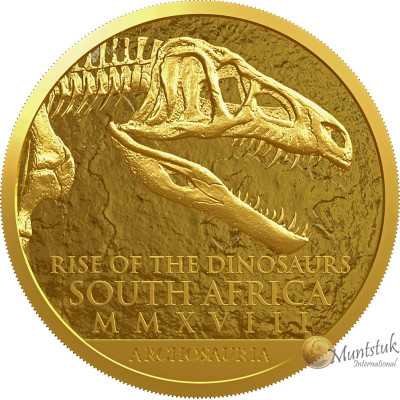


Natura - 2018, Gold - Palaeontology(Prestige Set - 5 Coin Set)
2018 Rise of the Dinosaurs (1 oz, 1/2 oz, 1/4 oz, 1/10 oz, 1/20 oz). Each coin issued has an individually numbered Certificate of Authenticity.

T&C for doing business with us

Shipping & Delivery Information

Privacy Notice and Informed Consent Notice
A new chapter in the award-winning Natura series begins with the introduction of palaeontology, in recognition of South Africa’s significance to this field and study of plant and animal fossils. In this first instalment of the palaeontology-themed coins, the focus is ‘Rise of the dinosaurs – Archosauria’ over the five 24ct gold coins.
The Karoo supergroup of South Africa is one of the geological wonders of the world. This 12 km thick layer of sedimentary rock was set down over a period of almost 120 million years when South Africa was still part of southern Gondwanaland.
The Archosauria- crocodiles, pterosaurs, dinosaurs and birds- or the ruling reptiles, were magnificent beasts which ruled over the land and sky for 180 million years, from the Triassic to the Cretacecous periods. The Archosauriforms evolved at the end of the Triassic, finally taking over the last enclaves of synapsid domination. The next step of evolution, which saw the rise of the dinosaurs, crocodiles and pterosaurs, was imminent
Each coin in this set depicts a different Archosauriform, together with its scientific name, the word ‘Natura’, the denomination, mass and metal value of the coin.
Reverse R100, 1 Oz: Depicts the Coelophysis rhodesiensis, a small, agile dinosaur which preyed on small animals, inhabited South Africa and Zimbabwe during the early part of the Jurassic period. This slenderly built, bipedal dinosaur grew up to 3 m long and weighed about 32 kg.
Reverse R50, 1/2 Oz: Depicts the Massospondylus carinatus, one of the best known dinosaurs in the world and also the most common dinosaur species in Southern Africa. Massospondylus is a prosauropod dinosaur and lived in the early Jurassic period, which makes it one of the oldest dinosaurs on earth.
It had a typical saurischian type pelvis with a forward-jutting pubis. Its length was 4 m to 6 m and it had a small head, narrow body and long neck and tail. Its hind limbs were much longer and stronger than its front limbs which, together with the morphology of the hips, indicate that it was a bipedal. The small serrated leaf-shaped teeth suggest it was probably an omnivore. Mass: 15.552g
Reverse R20, 1/4 Oz: Depicts the Proterosuchus ranged that were between 1.5 m to 2.2 m in length, and resembled the crocodile with their long jaw, short legs, thick neck and a long flattened tail. The elongated snout of this creature resembles that of a modern gharial, more than that of a crocodile or alligator which would suggest that it was a specialised fish-eater. Its nostrils are on the side of the snout, supporting the hypothesis that they were terrestrial predators hunting in water.
Reverse R10, 1/10 Oz: Depicts the Erythrosuchus africanus was approximately 5 m long and stood over 2 m tall, making it the largest predator of the time. The Erythrosuchidae would have been at the top of the food pyramid, preying on all other terrestrial vertebrates.
The Erythrosuchus had an exceptionally large skull for its size, occupying approximately a fifth of its total body length. Its teeth were as large as that of any large carnosaur, but curved like those of other Archosaurimorphs, suggesting that they preyed upon large prey animals which were difficult to subdue. This creature walked on all fours with a semi-erect gait which would have enabled it to move more swiftly than other more primitive reptiles of the same size. It would still have been a cumbersome animal given its size and for that reason it is speculated that it was an ambush predator.
Reverse R5, 1/20 Oz: Depicts the Euparkeria capensis, a small active predator, which could at speed run bipedally, had a protective double row of osteoderms along the length of its body like many other Archosauriforms. The size, agility, speed and small sharp teeth of Euparkeria would have made it ideally suited to be an insectivore. Euparkeria was one of the first bipedal vertebrates with their legs longer than their arms, which suggest that they could move around quadropedally, but at times, such as when they were running, they could become facultative bipeds and run on their hind legs. Bipedalism became a very important evolutionary adaptation inherited by the archosaurs, including dinosaurs and birds.
Natura Coin Specifications - Limited
| R100 (1 oz) | R50 (1/2 oz) | R20 (1/4 oz) | R10 (1/10 oz) | R5 (1/20 oz) | |
| 24 Carat Gold | 24 Carat Gold | 24 Carat Gold | 24 Carat Gold | 24 Carat Gold | |
| Mass: | 31.107 gram | 15.553 gram | 7.777 gram | 3.110 gram | 1.555g |
|
Diameter: |
32.69 mm | 27.00mm | 22.00mm | 16.50 mm | 12.00mm |
| Metal Content: | Au 999.9 | Au 999.9 | Au 999.9 | Au 999.9 | Au 999.9 |
| Reverse Die-Sinker: | MJ Scheepers | MJ Scheepers | MJ Scheepers | MJ Scheepers | MJ Scheepers |
| Reverse Artist: | MJ Scheepers | MJ Scheepers | MJ Scheepers | MJ Scheepers | MJ Scheepers |
| Obverse Die-Sinker : | MJ Scheepers | MJ Scheepers | MJ Scheepers | MJ Scheepers | MJ Scheepers |
| Obverse Artist: | MJ Scheepers | MJ Scheepers | MJ Scheepers | MJ Scheepers | MJ Scheepers |
- Material
- Gold
- Shape
- Round
- Time
- 2000s
- Object
- Dinosaur